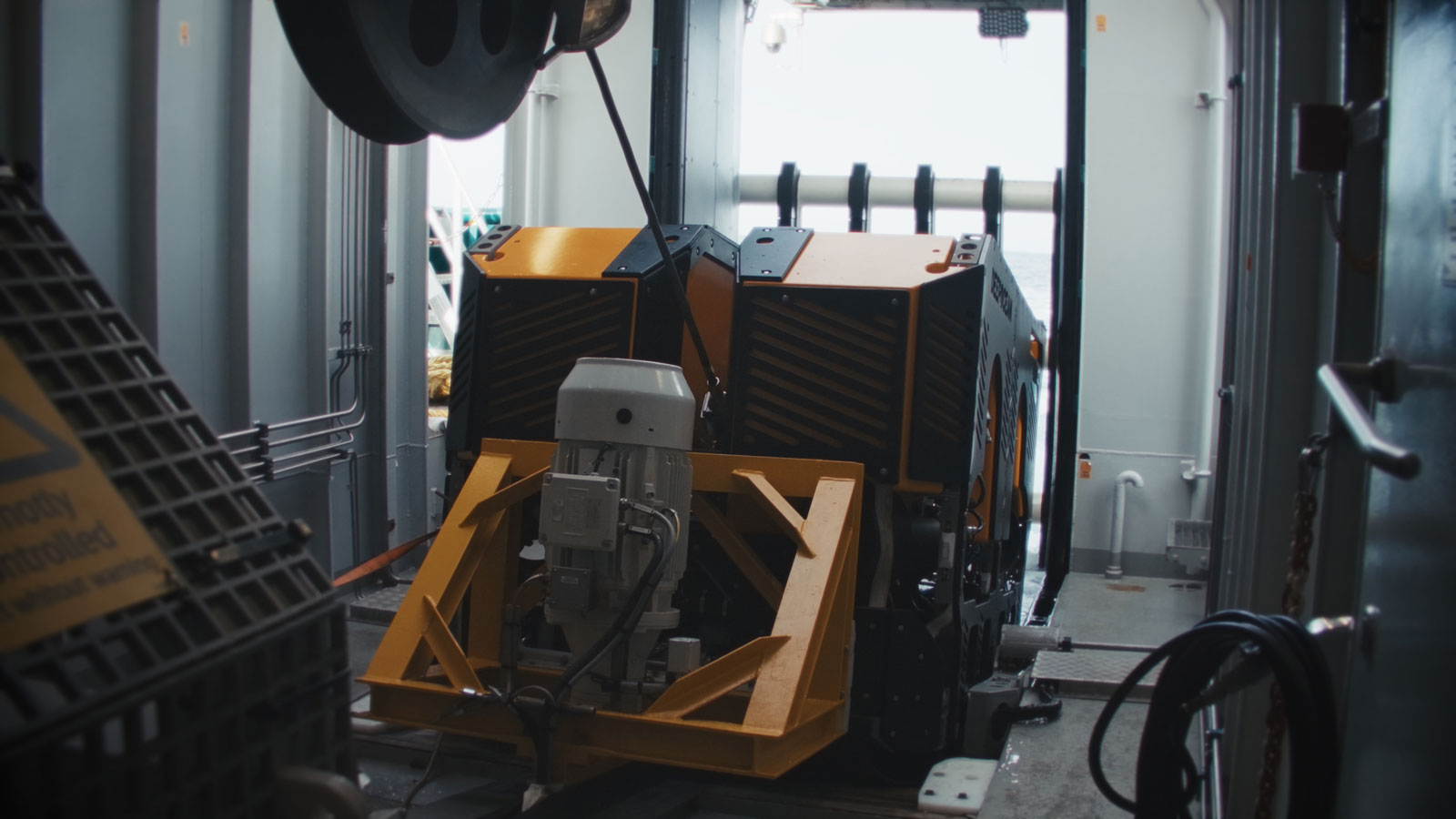
Evotec CORE™ Remote enables launch and recovery of ROVs to be carried out from shore as a single, automated operation. The solution is already in operational use with DeepOcean.
"We see a clear shift towards more remote and centralised offshore operations. With Evotec CORE™ Remote, we have taken an important step by consolidating complex operations into controlled sequences – and deploying this in live operations," says Kurt Erik Steinsåker Nesje, VP Automation at Evotec.
Evotec CORE™ Remote is a solution for remote launch and recovery of ROVs (Remotely Operated Vehicles), now in operational use by DeepOcean from its Remote Operations Center (ROC) in Haugesund.
Operations are carried out using the unmanned vessel USV Challenger, purpose-built for remote subsea operations.
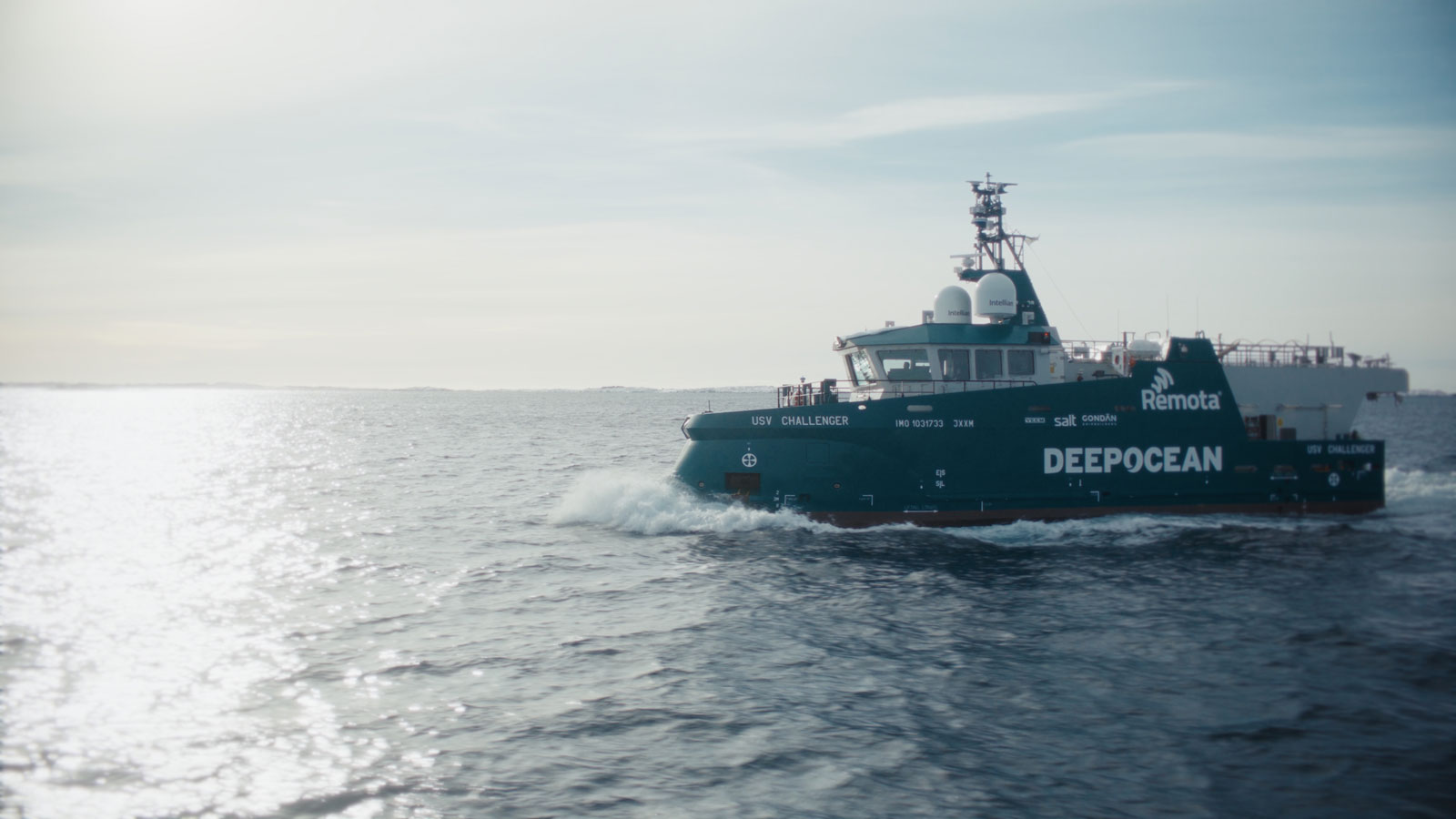
DeepOcean is a global provider of subsea services within inspection, maintenance, repair (IMR) and installation, with operations across several key international markets.
Launch and recovery as a single operation
"Now we press launch, and functions that were previously carried out one by one are executed in sync."
Eivind Bøe, ROV Engineer at DeepOcean, describes how launch and recovery has moved from a sequence of manual operations to one continuous, automated process.
"You would normally have a control interface where you operate multiple functions to deploy the ROV. Now we have replaced that with a single button that executes all functions."
This is not only about remote control, but about restructuring the operation itself. When multiple steps are combined into a defined sequence, execution becomes more predictable and less dependent on manual coordination.

The operation is relocated – not changed
From DeepOcean’s Remote Operations Center (ROC) at Killingøy in Haugesund, ROV operations are now carried out that previously required fully manned offshore setups.
"It’s as if you are onboard – but you’re not," says Bøe.
The operational experience is largely the same. The operator has access to the same systems, the same data and the same level of control – but the workspace has moved.
"We deliver the same services from shore as offshore across large parts of our subsea inspection and light intervention offering," says Johanne Halvorsen Øveraas, Operations Director, DeepOcean Northern Europe.
Reduced offshore manning – and increased safety
"The savings come from reducing the number of people who need to be offshore, away from their families for 14 days for an operation that may only take two days," says Roald Rykkje, Senior Project Engineer – Methods at DeepOcean.
"In a traditional operation, you can easily have 10–12 people involved just on the ROV and project side, in addition to a vessel with 25–30 marine crew. In total, you are often looking at 45–60 people offshore."
With remote operations, this is significantly reduced. Operators and key personnel can instead work from shore, without the need for rotation, travel or mobilisation for each individual project.
This not only reduces offshore manning requirements, but also enables more flexible use of competence, where the same resources can be deployed across multiple operations without being tied to a single vessel.
When operators are no longer required to be physically offshore, operations can also be carried out with an even higher level of safety.

Operator capacity can be shared
Remote operations enable a more dynamic use of operator resources.
"When an unmanned subsea vessel is in transit, you can work on ROV operations for another vessel that is on site," says Rykkje.
The operator is no longer physically tied to one vessel. Capacity can be allocated where it is needed, resulting in more efficient utilisation of available competence over time.
"When remote operations are scaled, you gain greater flexibility across vessels," says Johanne Halvorsen Øveraas.
Smaller vessels and lower energy consumption
Remote operations also influence how vessels are used and dimensioned.
"I have been involved in operations where offshore vessels of 100–120 metres sail for up to a full day to perform a simple task. Such a vessel can consume around 25 cubic metres of fuel per day in transit, and an additional 10–15 cubic metres per day when operating on DP," says Rykkje.
With fewer functions and fewer personnel required onboard, smaller and more energy-efficient vessels become viable.
The difference in energy consumption is significant, directly impacting both costs and emissions. The effect is not limited to a single operation, but reflects how the entire operating model can be built around smaller vessels, fewer offshore personnel and increased use of shore-based control.

Automation – with full control
Although operations are automated, control remains with the operator.
"All functions can still be operated manually. You can interrupt at any time," says Eivind Bøe.
He highlights the most critical phases of the operation:
"The critical phase is when the ROV is close to the vessel, both during deployment and recovery. That is when you need full control of movement."
It is precisely these phases that automation is designed to support – not replace – operator judgement.
"We have focused on the most critical parts of the operation and developed automated sequences that handle these in a controlled and predictable way," says Kurt Erik Steinsåker Nesje.
He explains how the system continuously works in the background to ensure stable execution:
"The system continuously monitors position, load and movement, and uses this data to control the operation in a structured manner."
The system is also designed to handle deviations and unexpected situations:
"The system will complete the operation to a defined safe position – or return to a safe position if a deviation occurs."
For the operator, this reduces complexity while ensuring that the ability to intervene is always retained.
Automation thus acts as both structure and safety layer around the operation – while decision-making remains with the human operator.
Structured execution of complex operations
At Evotec, this development is described as a shift in how operations are designed – a new standard for ROV operations.
"What we do is consolidate complex operations into controlled sequences. When you standardise execution, you achieve more predictable and consistent operations," says Steinsåker Nesje.
By reducing variation in how operations are performed, the risk associated with manual coordination and individual work methods is also reduced.
An established operating model
For DeepOcean, remote operations are already part of daily operations.
"Remote operations will impact safety, environmental footprint and cost," says Johanne Halvorsen Øveraas.
In today’s operations centre, multiple functions are already co-located.
"Here, the entire team can sit together. You have the bridge, the ROV pilot and operations in the same room, with survey and engineering teams supporting from adjacent areas."
At the same time, the company is expanding its onshore capacity significantly.
"We are currently building a new office in Haugesund that will accommodate around 500 employees, including an operations centre with up to 18 dedicated control rooms. From there, we can operate unmanned vessels, run ROV operations and handle reporting and follow-up – in parallel," she says.
A clear direction forward
The ambition is to move a larger share of operations from offshore to onshore.
"This gives us the capacity to relocate most personnel who do not need to be offshore. Those who do not require physical presence can work from shore and deliver the same services."
The shift towards remote operations is not only about technology, but about how operations are designed. Increasingly, work is planned for onshore execution, with reduced need for permanent offshore manning and a higher degree of centralised control.
"What we are seeing is not isolated solutions, but a fundamental change in how operations are structured," says Kurt Erik Steinsåker Nesje.
Evotec CORE™ Remote is developed within this context – where the objective is not only to enable remote control, but to make operations possible in a fundamentally different way: with fewer resources, lower costs, greater flexibility and more predictable execution.

Latest news

Remote launch and recovery of ROV in operational use with DeepOcean

One button. One touch. How ROV operations are performed from shore